Demystifying the HIPAA Security Risk Assessment: A Complete Compliance Guide
In the modern, digitally-driven healthcare ecosystem, patient data is both highly valuable and critically vulnerable. As organizations adopt electronic health records, cloud storage, and telemedicine platforms, securing electronic protected health information (ePHI) has become a primary operational challenge. The Health Insurance Portability and Accountability Act (HIPAA) Security Rule mandates that Covered Entities and Business Associates conduct regular, systematic HIPAA Risk Assessments to identify, analyze, and mitigate potential security vulnerabilities. This complete guide provides the framework, actionable checklists, and compliance insights required to build an elite, resilient compliance strategy.
Why Modern Healthcare Security Mandates Rigorous Risk Assessments
Healthcare cyberattacks are escalating in both frequency and severity. In response, the Department of Health and Human Services (HHS) Office for Civil Rights (OCR) continues to tighten cybersecurity regulations and increase enforcement penalties. A proactive HIPAA Risk Assessment is not merely a box-checking exercise; it is an organizational shield against ruinous financial penalties, catastrophic data breaches, and systemic operational downtime. Without a documented, comprehensive risk analysis, healthcare providers face not only regulatory non-compliance but also a profound loss of patient trust.
What is a HIPAA Risk Assessment?
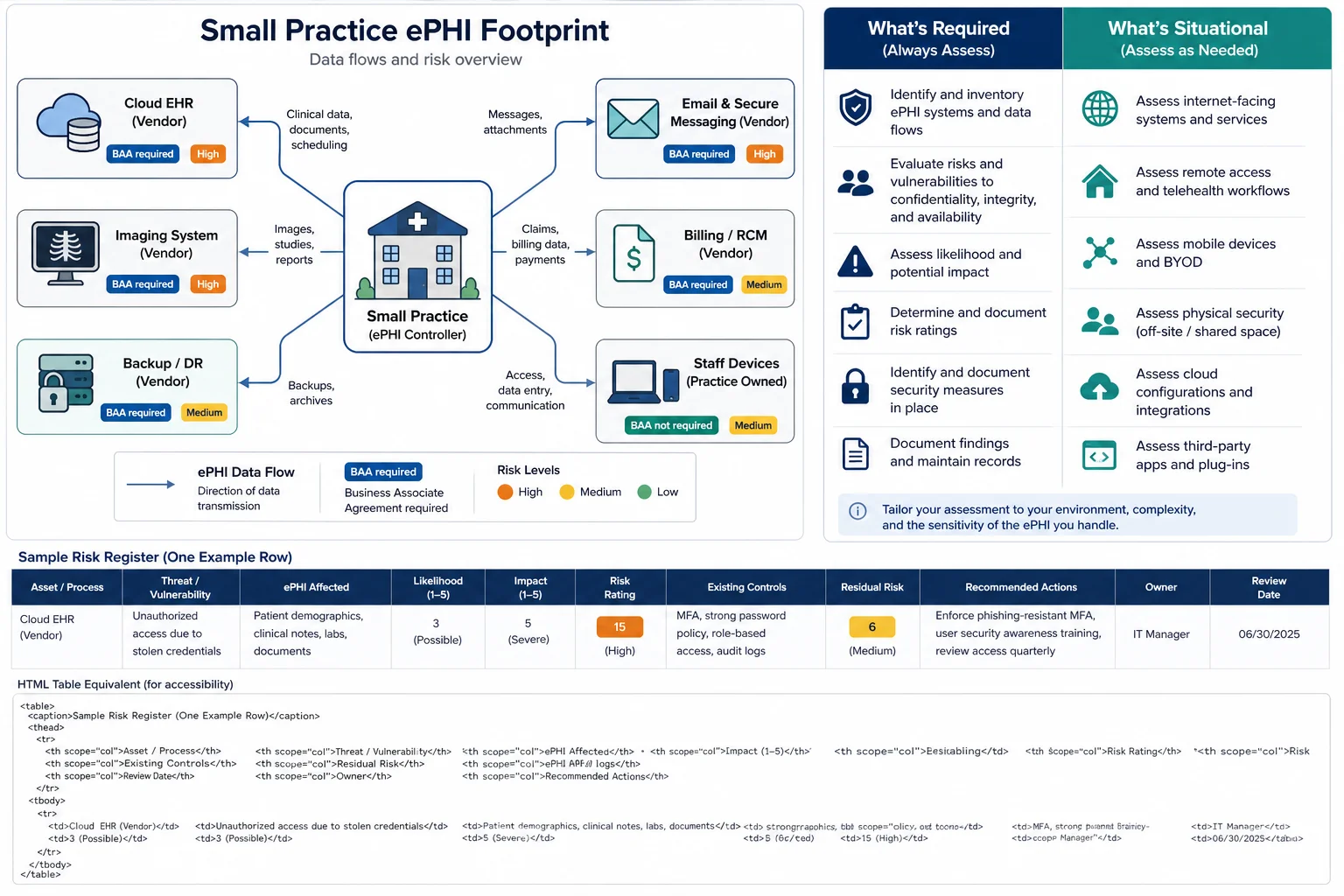
At its core, a HIPAA Risk Assessment is an ongoing, systematic evaluation of an organization’s security posture. It is designed to uncover vulnerabilities in the administrative, physical, and technical controls used to protect ePHI. Under 45 CFR section 164.308(a)(1)(ii)(A), the Security Rule requires organizations to conduct an accurate and thorough assessment of the potential risks and vulnerabilities to the confidentiality, integrity, and availability of ePHI held by the entity. This process encompasses every server, computer, workstation, smart device, cloud platform, and third-party vendor that interacts with patient records.
Secure your business and remote users
Get an All-In-One security stack, reduce lateral movement, and monitor every endpoint, fully managed for you. For just $1 per day.
Book a Meeting NowDifferentiating Covered Entities and Business Associates
Compliance is a shared responsibility across the entire healthcare supply chain. HIPAA distinguishes between two main classes of organizations, both of which are legally required to conduct risk assessments:
- Covered Entities (CEs): These are healthcare providers, health plans, and healthcare clearinghouses that directly transmit health information electronically. Examples include hospitals, dental clinics, pharmacies, and insurance providers.
- Business Associates (BAs): These are third-party organizations or subcontractors that access, transmit, create, or store ePHI on behalf of a Covered Entity. Examples include cloud hosting providers, medical billing companies, IT consultants, and physical document shredding services.
The Three Pillars of HIPAA Safeguards
To conduct an effective assessment, you must evaluate your organization against the three foundational pillars of the HIPAA Security Rule:
1. Administrative Safeguards
Administrative safeguards focus on the policies, procedures, and workforce management strategies that govern ePHI security. Your assessment must review security management processes, workforce clearance protocols, information access management policies, and mandatory employee security awareness training. Crucially, it must evaluate your contingency and disaster recovery plans, ensuring that your staff knows exactly how to respond during active cyber incidents.
2. Physical Safeguards
Physical safeguards protect the actual physical structures, equipment, and devices where ePHI is housed. You must analyze your facility access controls, workstation security, and device/media management. For example, are servers containing patient data secured in restricted-access rooms? Are backup hard drives encrypted and stored in fireproof safes? A comprehensive risk assessment examines physical vulnerabilities such as tailgating, unlocked offices, and unmonitored visitor entry.
3. Technical Safeguards
Technical safeguards involve the technologies used to protect ePHI and control access to it. Your evaluation must examine access controls (including unique user identification and automatic logoffs), audit controls that track who accesses specific records, integrity protocols to prevent unauthorized data alteration, and transmission security (such as end-to-end encryption for emails and data in transit). Assessing technical safeguards requires checking firewall configurations, multi-factor authentication (MFA) deployment, and patch management cycles.
The 6-Step NIST-Aligned Methodology for HIPAA Risk Assessment
An elite risk assessment follows structured industry frameworks, particularly those established by the National Institute of Standards and Technology (NIST) Special Publication 800-66. Use this six-step methodology to execute a thorough compliance analysis:
Step 1: System Characterization and Asset Inventory
You cannot protect what you do not know exists. Begin by documenting all systems, devices, physical storage media, and cloud environments that create, receive, maintain, or transmit ePHI. This includes creating a detailed network map, identifying server locations, and compiling a registry of all end-user workstations, mobile devices, and medical IoT devices.
Step 2: Threat Identification and Vulnerability Assessment
Analyze potential threats that could compromise ePHI. Threats generally fall into three categories: human threats (such as malicious hackers, phishing scams, or negligent employees), environmental threats (like power outages, floods, or fires), and technical threats (including system crashes, software bugs, or unpatched vulnerabilities). Pair these threats with vulnerabilities in your current infrastructure, such as outdated operating systems or weak password policies.
Step 3: Evaluate Current Security Controls
Document and evaluate the effectiveness of the security controls you already have in place. This includes checking if encryption is enabled on all portable devices, verifying that firewalls are properly configured, reviewing access control lists, and ensuring that workforce security training is up to date. Determine if these controls are sufficiently robust to mitigate the identified threats.
Step 4: Analyze Likelihood and Impact (Risk Rating)
Assess the likelihood of a threat exploiting a vulnerability and the potential impact of such an event. Establish a risk rating matrix (e.g., Low, Medium, High) based on factors such as financial costs, legal liability, regulatory fines, operational disruptions, and reputational damage. High-likelihood, high-impact risks require immediate remediation plans.
Step 5: Develop and Implement a Risk Mitigation Plan
Translate your risk assessment findings into a formal Corrective and Preventive Action (CAPA) plan. This document must outline specific mitigation strategies, assign clear responsibilities, define timelines, and allocate resources to address identified vulnerabilities. Prioritize high-risk areas first, such as enforcing multi-factor authentication across all remote access points or upgrading legacy systems.
Step 6: Document Findings and Maintain Continuous Monitoring
Comprehensive documentation is the cornerstone of regulatory defense. You must securely archive all risk assessment methodologies, notes, threat matrices, and mitigation plans. HIPAA compliance is not a static milestone; it requires continuous monitoring. Undergo a formal review annually, or whenever significant operational, technological, or organizational changes occur within your environment.
Common Pitfalls in HIPAA Compliance Assessments
Many organizations stumble during their risk assessment journey due to common, avoidable errors. These include treating the assessment as a one-time check-the-box activity rather than an active operational loop. Another common pitfall is failing to audit downstream Business Associates, leaving the organization exposed to third-party supply chain vulnerabilities. Additionally, failing to maintain meticulous documentation of both the assessment process and the corrective actions taken will result in significant OCR penalties during an audit, even if security controls are technically in place.
The Essential Modern HIPAA Security Checklist
To ensure your organization is completely prepared, verify the following elements in your risk assessment:
- Identity and Access Management: Are unique logins, strong password complexity, and multi-factor authentication enforced across all platforms?
- Encryption: Is ePHI encrypted both in transit (using protocols like TLS 1.3) and at rest (using AES-256)?
- Data Backups: Are secure, offline, or immutable backups maintained to defend against ransomware?
- Workforce Training: Have all employees completed documented security awareness training within the past 12 months?
- Incident Response: Is there a clear, updated incident response plan with defined procedures for identifying, mitigating, and reporting breaches?
The Strategic Role of GRC Solutions in HIPAA Compliance
Manually managing HIPAA risk assessments across complex healthcare networks using spreadsheets is inefficient, error-prone, and unsustainable. Modern Governance, Risk, and Compliance (GRC) platforms streamline the compliance journey by automating asset discovery, mapping controls directly to regulatory standards, tracking issues, and generating audit-ready documentation in real time. Transitioning to a GRC-driven framework breaks down data silos, promotes collaborative issue remediation, and provides leadership with continuous, high-visibility dashboards of the organization’s actual security posture.
Frequently Asked Questions
How often must a HIPAA risk assessment be performed?
While the HIPAA Security Rule does not specify a rigid calendar-based frequency, regulatory bodies and compliance standards expect a comprehensive assessment to be conducted at least once a year, or immediately following significant operational upgrades, structural mergers, or security incidents.
What are the consequences of failing to perform a HIPAA risk assessment?
Failing to perform a documented risk assessment is considered willful neglect under the HIPAA HITECH Act. This exposes the organization to tier-four civil monetary penalties, which can range up to fifty thousand dollars per violation, alongside severe loss of operational licenses and long-term damage to the company’s clinical reputation.
Can we use free government tools to conduct our assessment?
Yes, tools like the HHS Security Risk Assessment Tool are excellent starting resources for small-to-medium practices. However, larger healthcare systems or complex enterprise platforms often require more robust, customizable compliance frameworks and advanced GRC automation software to manage scale and multi-dimensional risks effectively.