Introduction: Navigating the 2026 HIPAA Security Landscape
For healthcare executives, compliance officers, and IT leaders, maintaining data privacy has always felt like chasing a moving target. However, in 2026, the regulatory landscape has undergone its most profound shift in over two decades. The federal government’s expectations have evolved beyond the traditional check-the-box compliance model. Today, federal enforcement is focused on a singular, critical distinction: the transition from static Risk Analysis to active, continuous Risk Management.
Organizations can no longer rely on annual security assessments that gather dust on a shelf. The Department of Health and Human Services (HHS) Office for Civil Rights (OCR) has made it clear that identifying vulnerabilities is only half the battle. If your organization is not actively mitigating, tracking, and validating those risks, you may be exposed to significant regulatory penalties, reputational damage, and class-action litigation.
The Proposed HIPAA Security Rule Overhaul: Understanding the NPRM
The groundwork for this new era of enforcement was laid in January 2025, when HHS published a comprehensive, 125-page Notice of Proposed Rulemaking (NPRM) aimed at updating the HIPAA Security Rule for the first time since 2003. This proposed rule represents an industry-wide modernizing effort, designed to align regulatory requirements with the sophisticated threat landscape of the mid-2020s.
Secure your business and remote users
Get an All-In-One security stack, reduce lateral movement, and monitor every endpoint, fully managed for you. For just $1 per day.
Book a Meeting NowThe most consequential proposed change is the elimination of the long-standing distinction between “required” and “addressable” implementation specifications. For years, many covered entities treated “addressable” specifications—such as data encryption or multi-factor authentication—as optional or discretionary guidelines. Under the new proposal, virtually all specifications become mandatory. This change eliminates the legal loopholes that previously allowed under-resourced or smaller providers to delay critical cybersecurity updates.
Furthermore, the NPRM mandates rigorous, written documentation for all security policies, procedures, incident response plans, and risk assessments. While some industry groups have pushed back against the projected $9 billion first-year implementation cost, federal regulators have signaled that the status quo is no longer tenable.
The True Cost of Inaction: OCR’s Regulatory Stance
Despite debates over the administrative and financial burdens of the new rules, OCR leadership has warned healthcare organizations against delaying security upgrades. Speaking on the modern regulatory landscape, Paula Stannard, Director of the HHS Office for Civil Rights, emphasized that the cost of compliance pale in comparison to the consequences of a breach.
“I want to encourage you not to overlook the very high cost of doing nothing,” Stannard noted. “A successful cyberattack can cost far more in terms of reputation—the need to pay ransom, remediation of your systems, protection for those whose protected health information was accessed, potential civil liability—and investors knocking at your door.”
OCR’s perspective is backed by alarming industry data. In 2024, large healthcare data breaches affected more than 286 million individuals. By 2025, over 76% of those major breaches were attributed to hacking and IT security incidents. Because these threats are highly predictable and constant, OCR argues that failing to implement robust defenses constitutes a failure to protect patient data under existing law, regardless of when the NPRM is fully finalized.
The Core Shift: Risk Analysis vs. Active Risk Management
To help healthcare entities navigate these expectations, OCR Senior Advisor for Cybersecurity Nick Heesters clarified that the agency has formally expanded its enforcement initiatives. Regulators are no longer just auditing whether an organization has conducted a Risk Analysis; they are actively investigating the quality of the organization’s Risk Management program.
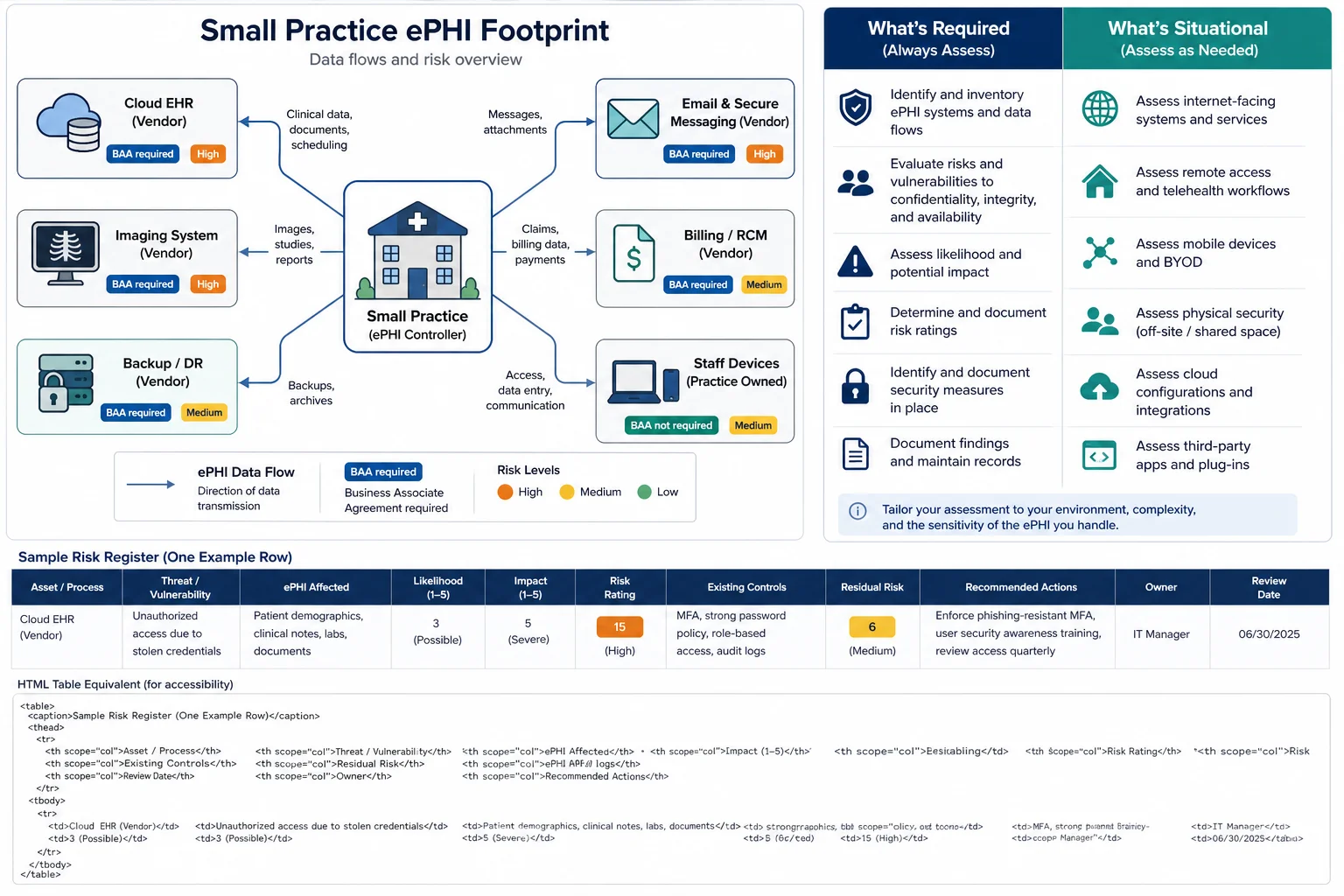
A Risk Analysis is a diagnostic tool—it identifies where electronic Protected Health Information (ePHI) is stored, how it flows, and what vulnerabilities exist. Risk Management, conversely, is the operational treatment plan. It is the structured process of prioritizing those identified risks, implementing controls to mitigate them, and continuously validating that those controls are working.
OCR investigations frequently reveal that organizations are fully aware of their vulnerabilities but fail to act on them. When the same unmitigated security gaps appear in annual risk assessments year after year, regulators categorize this inaction as “willful neglect.” This is the most severe tier of HIPAA violations, carrying mandatory penalties that can exceed $73,011 per day, per violation.
A Tactical Comparison: Analysis vs. Management
To help compliance officers structure their programs, the table below highlights the key differences between a static compliance posture and an active risk management program.
| Security Metric | Traditional Risk Analysis | Active Risk Management |
|---|---|---|
| Frequency | Annual or periodic check-the-box assessment. | Continuous, dynamic, and updated in real-time. |
| Primary Focus | Identifying vulnerabilities and documenting ePHI locations. | Remediating vulnerabilities, changing configurations, and testing controls. |
| Documentation | Static PDF report or binder of policies. | Living risk register with assigned owners and remediation timelines. |
| Verification | Assumed compliance based on policy language. | Empirical proof of security controls through continuous monitoring and testing. |
| Regulatory Defense | Weak; leaves organization vulnerable to “willful neglect” findings. | Strong; demonstrates a good-faith, proactive operational program. |
Implementing Recognized Cybersecurity Frameworks
Building a defensible security program requires a structured methodology. Rather than trying to invent a proprietary system, healthcare organizations should align their operations with federally recognized frameworks. Key standards include:
- NIST CSF 2.0 (National Institute of Standards and Technology Cybersecurity Framework): Provides a modern, flexible structure organized around six key functions: Govern, Identify, Protect, Detect, Respond, and Recover.
- NIST SP 800-66 Revision 2: Specifically designed to guide organizations in implementing the HIPAA Security Rule using the NIST framework.
- HHS 405(d) HICP (Health Industry Cybersecurity Practices): A collaborative industry-government effort that provides practical, cost-effective cybersecurity guidelines tailored specifically to small, medium, and large healthcare organizations.
Adopting these frameworks does more than just secure your digital environment; it provides a clear, documented roadmap that regulators respect. If your organization faces an OCR audit, being able to show that your security program is modeled directly on NIST or HHS 405(d) guidelines is an invaluable line of defense.
Action Plan: Transitioning to Active Risk Management
Transitioning your organization from passive compliance to active risk management requires a coordinated effort across compliance, IT, and executive leadership. Consider the following tactical steps:
1. Maintain a Comprehensive Asset Inventory
You cannot secure data that you do not know exists. Ensure your IT team maintains a real-time inventory of every asset, application, server, mobile device, and cloud service that stores or transmits ePHI. Pay special attention to legacy systems and shadow IT, which are common entry points for hackers.
2. Establish a Living Risk Register
Every vulnerability identified during your risk analysis must be logged in a centralized risk register. Each entry should include an assigned risk rating (Low, Medium, High, Critical), a designated owner, an actionable mitigation plan, and a firm remediation deadline.
3. Implement Continuous Controls Validation
Do not assume your security controls are functioning simply because a policy says they should be. Regularly test your defenses through automated vulnerability scanning, penetration testing, and simulated phishing campaigns. OCR expects to see empirical proof that your security measures are actively working in production environments.
4. Train Your Workforce Continuously
Technology alone cannot prevent a breach. Because the vast majority of cybersecurity incidents originate with human error, regular security awareness training is vital. Move away from once-a-year training modules in favor of micro-learning sessions and real-time feedback based on simulated attacks.
5. Secure Board-Level Buy-In
Cybersecurity is no longer just an IT problem; it is an enterprise risk issue. Ensure your executive team and board of directors understand the strategic importance of your risk management program. Securing the necessary budget and resources requires framing cybersecurity not as an administrative cost, but as an investment in operational resilience and patient trust.
Conclusion: The Path Forward
The regulatory shifts of 2026 present a clear challenge, but they also offer a significant opportunity. By moving beyond static checklists and embracing a culture of continuous risk management, your organization can build a resilient infrastructure capable of defending against modern threats. Ultimately, protecting patient data is not just about avoiding regulatory fines—it is a fundamental component of providing safe, high-quality healthcare.