Phishing in 2025–2026: AI-Driven Attacks, Deepfakes, and the Next Wave of Cyber Threats
Phishing in 2025 has entered a dangerous new era. Artificial intelligence, deepfakes, and automated reconnaissance have completely reshaped how cybercriminals target organizations. The volume is rising, the accuracy is improving, and the financial impact is accelerating at a historic pace.
However, 2025 is not the peak. 2026 will be worse unless organizations radically upgrade their defenses. This report goes beyond surface-level summaries. It provides strategic analysis, authoritative data, and expert predictions for the threats coming in 2026 that enterprises must prepare for now.
Phishing in 2025: The New Threat Reality
Attackers now use tools once reserved for nation-states. The accessibility of AI models, voice cloning kits, and automated reconnaissance systems has dramatically lowered the barrier to entry for sophisticated phishing campaigns.
Secure your business and remote users
Deploy the SecureTrust stack, reduce lateral movement, and monitor every endpoint, fully managed for you.
Book a Meeting NowKey Trends Driving Phishing Growth in 2025
- Perfectly written AI-generated emails indistinguishable from legitimate internal messages.
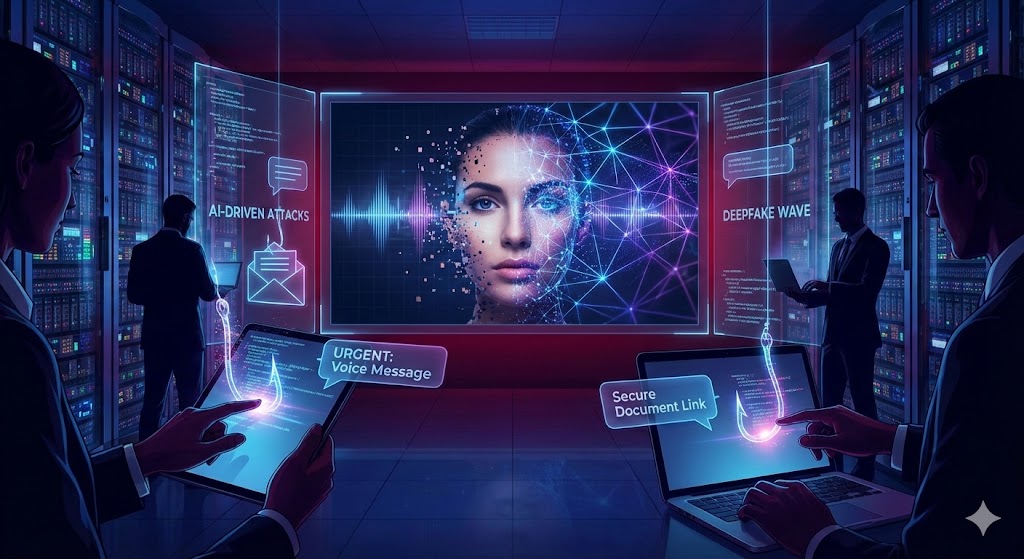
- Deepfake-enabled Business Email Compromise (BEC) executed in real time during calls or video meetings.
- SaaS impersonation attacks exploiting platforms such as Microsoft 365, Google Workspace, QuickBooks, and Salesforce.
- MFA bypass platforms normalizing token theft-as-a-service.
- Multi-platform “omni-phishing” via email, SMS, WhatsApp, LinkedIn, Slack, and Teams to build credibility.
Phishing has become multi-stage, multi-channel, and behaviorally tailored. It is no longer a simple malicious email; it is a coordinated social engineering campaign.
Current Statistics and Impact (2024–2025)
Recent industry reports show the scale of the problem:
- 67% of breaches involved phishing or social engineering (Verizon DBIR 2024).
- 93% of ransomware incidents began with a phishing interaction (IBM Cost of a Data Breach Report).
- Deepfake fraud increased by more than 700% year-over-year, according to the U.S. Federal Trade Commission.
- BEC losses exceeded $3.1 billion annually (FBI IC3 2024).
- QR-code phishing (quishing) rose over 500% as corporate “QR normalcy” spread across offices and services.
For further reference, see these authoritative sources:
- FBI Internet Crime Complaint Center (IC3)
- IBM Cost of a Data Breach Report
- CISA – Secure Our World
- U.S. Federal Trade Commission (FTC)
How Modern Phishing Attacks Work in 2025
AI-Generated Social Engineering
Attackers use large language models to generate content that matches corporate communication styles and regional language patterns. Combined with automated persona profiling and public data scraping, phishing emails now:
- Mimic real internal conversations and workflows.
- Include correct names, roles, and project references.
- Target users in their native language with local context.
Multi-Channel Impersonation (“Omni-Phishing”)
Instead of a single suspicious email, attackers create a network of legitimacy across channels:
- Email confirming an “update”.
- SMS or messaging app reminders.
- LinkedIn or Teams messages reinforcing the story.
- Voicemail or deepfake voice calls escalating urgency.
After multiple touchpoints, victims are far more likely to trust the request and take action.
Deepfake Voice and Video Fraud
Deepfake technology has moved from novelty to operational tool. Attacks now include:
- Real-time voice clones of executives issuing payment instructions.
- Manipulated Zoom/Teams calls with synthetic faces and voices.
- Pre-recorded “emergency” videos that appear authentic to non-technical staff.
These attacks bypass technical controls and exploit authority, urgency, and trust.
SaaS Platform Exploitation
Attackers increasingly deliver phishing content and malware through legitimate cloud and SaaS platforms, including:
- SharePoint and OneDrive.
- Google Drive and Google Workspace.
- DocuSign, QuickBooks, and e-signature tools.
- GitHub and code hosting services.
Users are accustomed to trusting these platforms, and many secure email gateways treat traffic from them as low risk, giving attackers an advantage.
Credential and Session Theft with MFA Bypass
Multi-factor authentication is no longer a guaranteed safeguard. Attackers now routinely use:
- Real-time phishing proxies.
- Man-in-the-middle tools that steal session tokens.
- MFA fatigue attacks that bombard users with approval prompts.
- Browser-in-the-browser impersonation of login portals.
The result is clear: MFA alone is no longer sufficient as a defensive measure.
Real-World Phishing Attacks (2024–2025)
Case Study 1: Deepfake CFO Fraud
A global organization wired tens of millions of dollars after finance staff joined a video call with what appeared to be the CFO and legal counsel. Both were deepfake avatars. The attackers used publicly available video to train models and then instructed staff to process “confidential, time-sensitive” transactions.
Case Study 2: Microsoft 365 Real-Time Token Theft
A large enterprise experienced account takeovers after employees logged into a perfectly cloned Microsoft 365 login page. A real-time proxy passed credentials and MFA codes to the attackers, who immediately established sessions and created inbox rules to hide their activity.
Case Study 3: QR-Code Credential Harvesting
At a manufacturing site, attackers replaced physical building-entry QR codes with malicious codes. Scanning employees were redirected to realistic mobile login pages where attackers harvested credentials and subsequently accessed internal systems.
Top Phishing Attack Types in 2025
- BEC 3.0: AI scripts plus deepfake voices and fake Teams or Zoom meetings.
- LLM-powered spear phishing: persona-based targeting using open-source intelligence.
- SaaS-delivered phishing: malicious documents and links hosted on trusted cloud platforms.
- Malvertising and search engine poisoning: fake ads and cloned sites distributing malware.
- QR-code phishing (quishing): malicious QR codes in physical and digital environments.
- Messaging app impersonation: WhatsApp, Signal, Telegram, Slack, and Teams phishing.
- Password reset traps: fake security prompts and policy update requests.
How to Protect Your Organization in 2025
Implement a Zero Trust Identity Architecture
Zero Trust helps reduce the blast radius when credentials, devices, or sessions are compromised. Key elements include:
- Continuous authentication and risk-based access.
- Device posture checks and trust scoring.
- Least privilege access and strong role-based controls.
- Network and application segmentation to limit lateral movement.
- Behavioral analytics to detect anomalies and suspicious patterns.
For a deeper overview, see your internal Zero Trust security guide (internal link suggestion).
Use Phishing-Resistant MFA
Organizations should pivot to phishing-resistant authentication methods, including:
- FIDO2 security keys.
- WebAuthn-based authenticators.
- Passkeys bound to devices and trusted platforms.
Avoid relying on SMS codes, push-based approvals, and basic TOTP apps where possible. For more detail, link to an internal resource such as How FIDO2 and passkeys work.
Strengthen Email and SaaS Security
Modern phishing defense requires more than traditional spam filters. Organizations should deploy:
- Email security tools with LLM-based anomaly detection.
- Impersonation and vendor fraud detection capabilities.
- Attachment and URL sandboxing for detonating suspicious content.
- Strict domain authentication with DMARC, DKIM, and SPF.
- CASB and SaaS posture management for OAuth app control and token monitoring.
Reduce Deepfake Fraud Risk
Process changes are as important as technical controls. Consider:
- Mandatory out-of-band verification for financial or sensitive approvals.
- No final approvals based solely on video calls.
- Dual-control policies for large payments or changes to payment instructions.
- Deploying tools that help flag potential deepfake audio or video anomalies.
Continuous Employee Training
Security awareness must evolve to match the threat landscape. Training should cover:
- Recognition of AI-generated and deepfake content.
- Multi-channel phishing tactics and how they build trust.
- Social media exposure and oversharing risks.
- Reporting and escalation processes for suspicious communications.
Training should be frequent, scenario-based, and aligned with actual attack patterns observed in your environment.
Predictions for 2026: What Comes Next
2025 has already been an inflection point for phishing. The emerging tools and underground service offerings clearly indicate where 2026 is headed.
Prediction 1: AI Autonomous Phishing Bots
By mid-2026, fully autonomous attack systems are likely to:
- Scrape organizational and employee data across public sources.
- Generate and send personalized phishing messages at scale.
- Schedule follow-ups and cross-channel touches automatically.
- Adapt content in real time based on victim engagement.
The result will be mass-volume campaigns that still feel targeted to each individual.
Prediction 2: Deepfake Video Meetings Become Routine Attack Vectors
Attackers will treat Teams and Zoom meetings as primary delivery channels by:
- Joining as deepfaked executives, vendors, or legal advisors.
- Leveraging shared screens and chat to direct victims to malicious actions.
- Using pre-recorded video combined with real-time voice cloning.
Visual trust in video conferencing will become a liability if organizations do not adapt.
Prediction 3: Real-Time MFA Hijacking Becomes Commodity
Token theft and session hijacking-as-a-service will become widely accessible. Expect:
- More sophisticated browser-in-the-browser attacks.
- Increased use of malicious browser extensions.
- Real-time relays that bypass even strong OTP-based MFA.
Prediction 4: Supply Chain Phishing Disguised as AI Automation
Phishing campaigns will increasingly impersonate:
- AI assistants used by vendors and partners.
- Automated invoice reconciliation or contract review tools.
- AI “security advisors” prompting users to reset credentials.
These attacks will blend seamlessly into legitimate automation workflows.
Prediction 5: Phishing Through AR/VR and Spatial Interfaces
As AR/VR and spatial computing become more common in enterprises, attackers will target:
- Fake system alerts inside AR/VR environments.
- Impersonated avatars of colleagues or managers.
- Malicious “virtual documents” or 3D objects triggering actions.
Prediction 6: Hyper-Targeted Psychological Phishing
AI models will increasingly be used for psychological profiling, enabling:
- Messages tuned to individual fears, values, and beliefs.
- Tailored narratives using personal, political, or social context.
- Persistent engagement campaigns that build a relationship over weeks or months.
Prediction 7: Phishing Directly Targeting Passkeys
Although passkeys are more secure than passwords, attackers will attempt to:
- Trick users into syncing or exporting credentials to malicious apps.
- Exploit device management or backup mechanisms.
- Leverage compromised endpoints to misuse locally stored passkeys.
Strategic Takeaways for Security Leaders
- Assume that phishing will bypass traditional controls and plan for containment.
- Accelerate the adoption of Zero Trust and phishing-resistant MFA.
- Invest in identity-centric security, behavioral analytics, and SaaS visibility.
- Update security awareness and executive training to cover deepfakes, AI social engineering, and multi-channel threats.
- Continuously test defenses with realistic phishing simulations aligned to current attack patterns.
Phishing in 2025–2026 will continue to evolve. Organizations that modernize now will dramatically reduce their risk. Those that rely on outdated defenses will become predictable, high-value targets.